Overhead Power Lines
Contact with overhead power lines is a leading cause of electrocution on jobsites. Electricity can jump (arc) to a ladder, boom or tool that gets close, without touching the line.
- Construction
- General Industry
Assume every line is energized
Overhead lines are usually bare, not insulated. The coating you see on some lines is weatherproofing, not insulation. Unless the utility has confirmed the line is de-energized and grounded, treat it as live.
Keep your distance
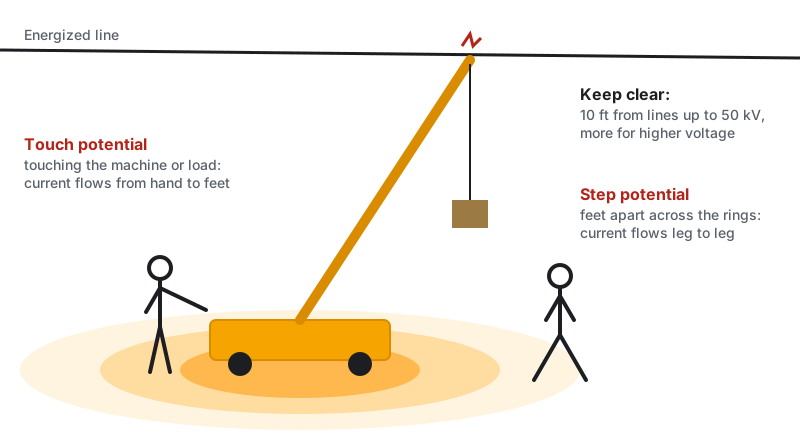
- People, ladders, scaffolds and tools: stay at least 10 feet away from lines up to 50 kV, and farther for higher voltages.
- Cranes and equipment that can reach the lines: if any part could get within 20 feet of a line up to 350 kV (50 feet over 350 kV), the employer must take specific precautions such as contacting the utility, using a dedicated spotter, warning lines and proximity alarms. See Crane Safety Basics.
- If you don’t know the voltage, ask the utility, and stay farther away.
Higher voltage, bigger distance
For cranes and similar equipment, OSHA’s minimum clearance table looks like this (when the employer has confirmed the voltage with the utility):
| Voltage (nominal, kV) | Minimum clearance |
|---|---|
| Up to 50 | 10 feet |
| Over 50 to 200 | 15 feet |
| Over 200 to 350 | 20 feet |
| Over 350 to 500 | 25 feet |
| Over 500 to 750 | 35 feet |
| Over 750 to 1,000 | 45 feet |
For unqualified workers in general industry, the rule is 10 feet up to 50 kV, plus 4 inches for every 10 kV over 50 kV. You usually can’t tell the voltage by looking at a line, so ask the utility.
How contacts happen
- Dump truck beds raised while moving or under lines
- Concrete pump booms, drill rigs, cranes and excavators swinging or booming up
- Aluminum ladders being raised, moved or carried
- Scaffolds erected or moved near lines
- Long pipe, rebar, conduit, gutters, siding or irrigation pipe carried upright
- Roof, siding and painting work near the service drop to a building
- Tree trimming near lines (only line-clearance tree trimmers may work close)
Why stepping away can kill
When a line contacts equipment or falls to the ground, current spreads out through the ground in rings, with voltage dropping as it moves away. If your feet are in two different rings, current flows up one leg and down the other (step potential). If you touch energized equipment while standing on the ground, current flows through your body (touch potential). That’s why you stay put or shuffle away with your feet together.
Prevention
- Look up and around before raising ladders, booms, dump bodies, scaffolds and long materials (pipe, rebar, gutters).
- Have the utility de-energize and ground lines, or install insulating covers, when work must be close.
- Use a dedicated spotter whose only job is watching clearance.
- Mark lines with elevated warning lines or flagging.
- Carry ladders and long materials horizontally.
- Lower dump bodies and booms before traveling, and don’t raise them under lines.
- Plan material storage and equipment setup away from lines.
- Check whether your state requires you to notify the utility before working near lines. Many do.
Before work near lines
- All overhead lines identified and marked on the site plan
- Voltage confirmed with the utility, or the larger distance assumed
- Utility contacted about de-energizing, grounding, covering or relocating lines
- Minimum clearance distances set and marked with warning lines or flags
- Dedicated spotter assigned for equipment that could reach the lines
- Crew briefed on what to do if contact happens
If your equipment contacts a line: stay in the cab if you can, warn others to stay away, and call the utility and 911. If you must get out because of fire, jump clear with both feet together without touching the machine and the ground at the same time, then shuffle away with small steps, feet together. Never touch someone or something in contact with a line.
Standards & references
- 29 CFR 1926.416(a): Protection of employees
- 29 CFR 1926.1408: Power line safety (cranes, up to 350 kV)
- 29 CFR 1910.333(c)(3): Overhead lines (general industry)
Last updated: