Fall Restraint Systems
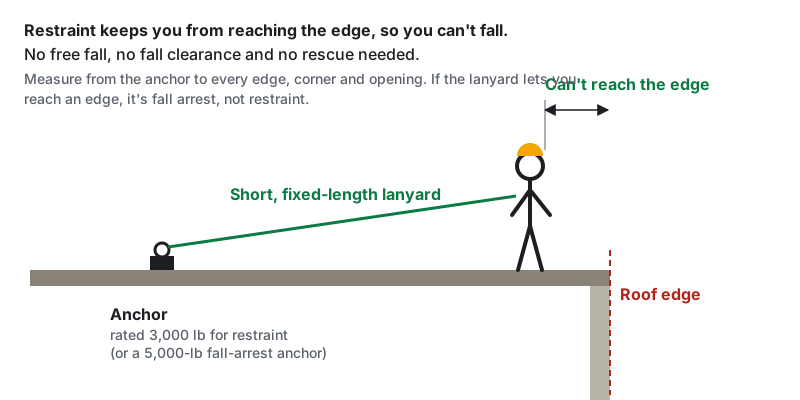
A fall restraint system uses a harness and a short connection to an anchor so you physically can’t reach the edge. Unlike fall arrest, nobody falls, so there’s no fall to stop, no fall clearance to calculate and no one hanging in a harness waiting for rescue. When it’s possible, restraint is usually the better choice.
- Construction
- General Industry
Restraint vs. arrest
| Fall restraint | Fall arrest | |
|---|---|---|
| Can you fall? | No. You can’t reach the edge | Yes. The system stops the fall |
| Fall clearance needed | None | Often 18 feet or more |
| Shock absorber needed | No | Yes |
| Rescue plan | Not needed for a fall | Required |
| Injury risk if it’s used | Very low | Arrest forces, swing, suspension trauma |
| Main limitation | Only works when the anchor is far enough from the edge | Works right at the edge |
Where restraint works well
- Low-slope and flat roofs with an anchor near the center, such as for HVAC service, roof inspections and skylight work
- Truck and trailer tops with an overhead rail that limits travel
- Mezzanines and platforms where you need to approach, but not reach, an opening
- Aerial lifts: in a boom lift, a short lanyard to the basket anchor keeps you in the platform (see Aerial Lifts)
Restraint works poorly on steep roofs, where you could slide even before reaching the edge, and anywhere you need to work at the edge itself.
Setting it up
- Find the nearest edge. Measure from the anchor to every edge, corner, skylight and roof opening you could walk toward. Corners are farther away than the sides, so the nearest straight edge usually controls.
- Pick the length. Your total reach is the lanyard length plus your harness and body. Set the lanyard so that when it’s fully tight in any direction, your feet stop well short of the edge. Many companies require a few feet of margin.
- Use the right connector. A fixed-length lanyard, an adjustable rope lanyard or a rope grab on a lifeline all work. Some SRLs can be used for restraint; check the instructions.
- Test it. Before starting work, walk toward the edge in every direction with the line taut to confirm you stop short.
- Recheck whenever you move the anchor, change lanyards or the work area changes.
Anchors and equipment
- Use a full-body harness. Body belts may be allowed for restraint in some cases, but a harness protects you if the set-up turns out to allow a fall.
- Use anchors strong enough for restraint. OSHA has said restraint anchors should hold at least 3,000 pounds or twice the foreseeable force. Many sites simply use anchors rated for fall arrest (5,000 pounds).
- Inspect the harness, lanyard and anchor before each use, the same as for fall arrest.
- Avoid running the line over sharp edges, roof hatches or equipment that could cut it.
Warning: If the lanyard is long enough to let you reach the edge, it’s no longer a restraint system. It must then meet all fall arrest requirements, including a shock absorber, clearance and a rescue plan.
Common mistakes
- Measuring to the nearest edge but forgetting the skylight or roof hatch behind you
- Using a long rope lanyard “set short” that someone later lengthens
- Moving the anchor without re-measuring
- Two workers sharing one anchor with lines that can tangle or pull each other
- Using restraint on a slippery or steep roof where you can slide off before the line goes tight
Set-up checklist
- Distance from anchor to every edge and opening measured
- Lanyard length set so I stop short of the edge in every direction
- Harness, lanyard and connectors inspected
- Anchor strength confirmed (3,000 pounds or rated fall-arrest anchor)
- Walk-test done with the line taut
- Plan to re-measure if the anchor or work area changes
Standards & references
- 29 CFR 1910.140: Personal fall protection systems (travel restraint)
- 29 CFR 1910.28(b)(13): Work on low-slope roofs (general industry)
- 29 CFR 1926.502: Fall protection systems criteria (construction)
- See also: Personal Fall Arrest Systems · Working on Roofs
Last updated: