Guardrail Systems
Guardrails are one of the best forms of fall protection. They prevent the fall from happening, protect everyone in the area, and don’t depend on each worker remembering to clip in. In the hierarchy of fall protection, guardrails come before harnesses whenever they can be used.
- Construction
- General Industry
Where guardrails are used
- Slab edges and open sides of floors on buildings under construction
- Around floor holes, stairwells, shafts and skylights
- Roof edges, using clamp-on or counterweighted systems
- Ramps, runways, platforms and mezzanines
- Along excavations, pits and wall openings
- On scaffolds, lifts and work platforms
Requirements
| Part | Requirement |
|---|---|
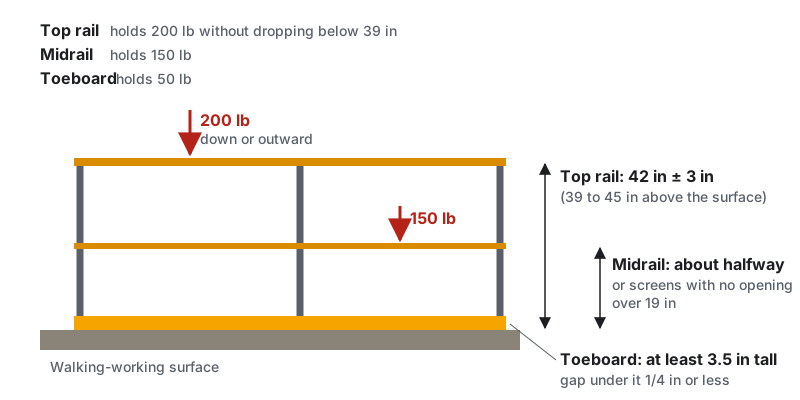
| Top rail height | 42 inches, plus or minus 3 inches (39–45 in) above the walking surface |
| Top rail strength | Withstand at least 200 pounds applied within 2 inches of the top edge, downward or outward, without dropping below 39 inches |
| Midrail | About halfway between the top rail and the walking surface; withstand 150 pounds |
| Openings | If screens, mesh or vertical members are used instead of midrails, no opening wider than 19 inches |
| Rail size | At least 1/4 inch thick or in diameter, so the rail won’t cut a hand |
| Toeboards | At least 3.5 inches tall, no more than 1/4 inch gap at the bottom, and hold 50 pounds |
| Wire rope rails | Flagged at least every 6 feet with high-visibility material |
| Surface | Smooth enough to prevent cuts, punctures and snagged clothing |
Scaffold guardrails have slightly different heights. See Scaffold Safety Basics.
Things that aren’t guardrails
- Caution tape, danger tape, or rope without flags and tension
- Steel or plastic banding
- A single 2×4 nailed across an opening with no midrail
- Stacked material, buckets or sawhorses
- Warning lines (they warn; they don’t stop a fall)
Openings, gates and hoist areas
- At ladder and stair access points, use a self-closing gate or an offset opening so no one can walk straight through.
- At hoisting areas, a chain, gate or removable rail must close the opening whenever material isn’t being landed.
- Around holes, guardrails go on every unprotected side. See Holes & Floor Openings.
Removing a section to land material
- Get permission from your supervisor or competent person.
- Everyone near the opening uses personal fall arrest or restraint before the rail comes off.
- Keep the opening as small as possible and open as briefly as possible.
- Put the rail back immediately, and check it before anyone leaves the area.
Using guardrails safely
- Check guardrails before relying on them: secure posts, no missing sections, rails tight.
- Report damaged rails right away. Equipment and material deliveries often knock them loose.
- Keep the area along the rail clear so no one has to step around material near the edge.
- Don’t sit, lean or stand on guardrails.
- Don’t tie off to guardrails. They aren’t rated anchors.
- Don’t stack material against guardrails so it raises the walking surface. Every inch you stand higher reduces the rail height.
- Don’t hang tools, cords or loads on rails.
Daily guardrail check
- Top rail between 39 and 45 inches above the surface everywhere
- Midrail or screen in place, no gaps over 19 inches
- Posts and clamps tight; counterweights in place
- Toeboards where people work or pass below
- Wire rope tight and flagged
- Gates close on their own at access points
- No removed sections left open
Video: inspecting a temporary guardrail on a slab edge
Standards & references
- 29 CFR 1926.502(b) and (j): Guardrail systems and toeboards
- 29 CFR 1910.29: Fall protection systems criteria (general industry)
- 29 CFR 1926.451(g)(4): Scaffold guardrails
Last updated: