Pump Jack Scaffolds
Pump jacks are platforms that ride up and down on vertical poles. Crews use them for siding, trim, windows, gutters and roofing on houses and small buildings. They go up fast, and they’re easy to set up wrong. Most pump jack failures come from bad bracing, weak poles or overloaded planks.
- Construction
- Residential
How a pump jack works
Each pole stands on the ground and is braced to the wall. A metal bracket (the jack) grips the pole. Pumping a foot pedal ratchets the jack up the pole; a crank or release lowers it. Planks span between two or more jacks to make the work platform, and a workbench or guardrail sits on the outside.
Set-up requirements
- Pump jack brackets, braces and accessories are made of metal, and each bracket has two positive gripping mechanisms so it can’t slip down the pole
- Poles stand on firm, level footing (mudsills or base plates), not on loose soil, blocks or bricks
- Poles are secured to the structure with rigid triangular bracing (or equal) at the bottom, top and other points as needed
- Wood poles are straight-grained and free of large knots, splits and other defects; spliced 2×4 poles have mending plates at every splice
- Poles are no farther apart than the manufacturer allows (and no more than 10 feet apart when wood planks are used)
- The platform is fully planked, with planks extending at least 6 inches and no more than 12 inches past the jack unless guarded
- A competent person supervises erection and inspects the scaffold before each shift and after anything that could damage it
Passing a brace
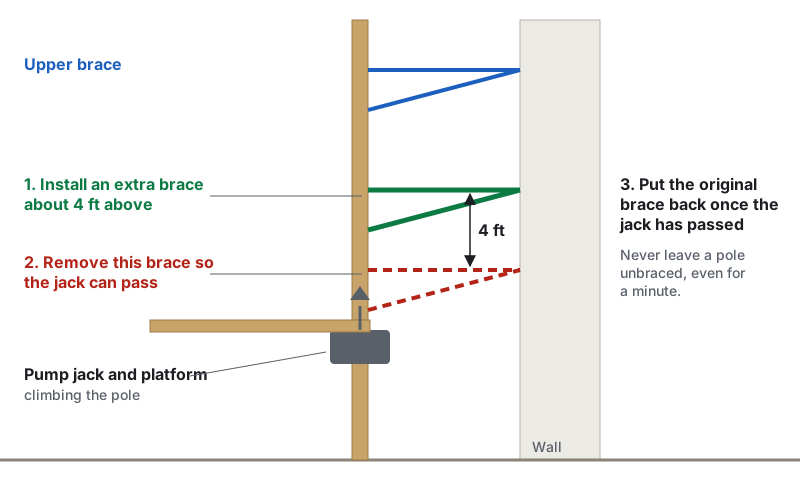
As the jack climbs, it eventually reaches a brace. OSHA’s rule: before removing a brace to let the jack pass, install an extra brace about 4 feet above the one you’re removing. Leave it in place until the jack has passed and the original brace is back on. Never leave a pole unbraced “just for a minute.”
Fall protection
- Use guardrails or personal fall arrest when the platform is 10 feet or more above a lower level.
- A workbench can be used as the top rail only if it meets guardrail height and strength requirements. Many don’t.
- If you use a harness, the anchor must be on the building or a separate anchor, not on the pump jack pole, unless the manufacturer says the pole is rated for it.
- Ends of the platform need guardrails too, not just the outside face.
Using pump jacks
- Follow the manufacturer’s load limits. Most systems limit the number of workers per span; check the label and instructions.
- Raise both jacks evenly so the plank stays level. Communicate with your partner before pumping.
- Keep material loads light and spread out. Stack siding and tools on the bench, not in a pile in the middle of a plank.
- Climb on and off at a safe access point, such as a ladder tied off at the platform level.
- Stay at least 10 feet from overhead power lines when raising poles and working, and farther from high-voltage lines.
- Don’t stand on the workbench. It is not a platform.
- Don’t use cracked, split or warped poles or planks.
- Don’t set poles on frozen ground that will thaw, or next to an open trench.
- Don’t mix parts from different manufacturers.
- Don’t leave the jacks high overnight in windy weather. Lower and secure the platform.
Watch the wall: Bracing is only as strong as what it’s attached to. Fasten braces into framing, not just sheathing or old siding. When removing siding or trim, plan where the braces will go first.
Training
Anyone who works on a scaffold must be trained by a qualified person to recognize the hazards and use the scaffold correctly. Workers who erect, move or take down pump jacks need additional training from a competent person. See Scaffold Safety Basics.
Standards & references
- 29 CFR 1926.452(j): Pump jack scaffolds
- 29 CFR 1926.451: General scaffold requirements (planking, access, inspection, power lines)
- 29 CFR 1926.454: Scaffold training
- See also: Siding & Gutter Installers
Last updated: