Suspended Scaffolds & Swing Stages
Suspended scaffolds hang from ropes rigged off the roof of a building. They’re used for window installation, facade repair, caulking, painting and cleaning. Everything depends on the rigging at the top. If a support device, tieback, rope or hoist fails, workers can fall many stories, so every part of the system gets checked every shift.
- Construction
- General Industry
Photo: two-point swing stage with workers tied off to independent vertical lifelines
Types of suspended scaffolds
- Two-point (swing stage): a long platform hung from two ropes, one at each end, with a hoist on each. The most common type.
- Single-point: a seat or small cage on one rope, like a boatswain’s chair.
- Multi-point and mast-climbing: larger platforms for heavy facade work.
- Rope descent systems: controlled-descent seats used mainly for window cleaning (general industry rules apply).
The rigging on the roof
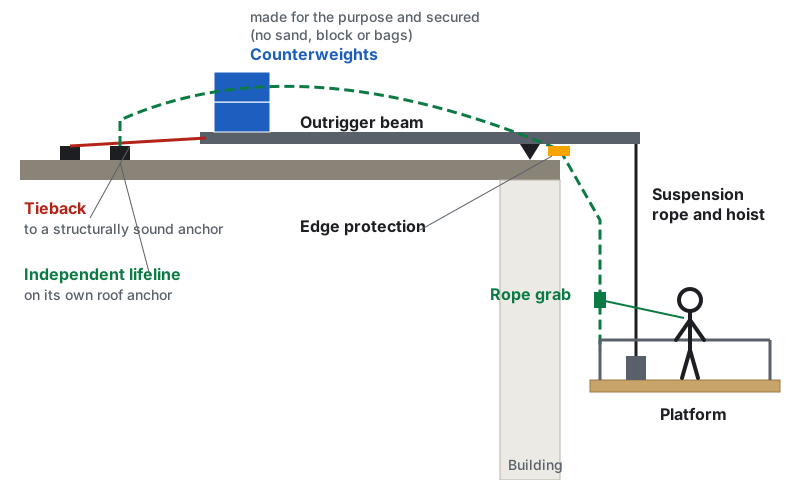
- Support devices (outrigger beams, parapet clamps, cornice hooks, roof hooks) must be designed for the load and set up under a competent person.
- They must rest on surfaces that can hold at least four times the load the scaffold puts on them at its rated load.
- Counterweights must be made for the purpose and secured to the outrigger. Sand, gravel, roofing material, masonry units or bags of anything are not allowed.
- Tiebacks: every support device must be tied back to a structurally sound anchor, such as a building column or engineered roof anchor. Vent pipes, standpipes and conduit are not anchors.
- Tiebacks must be as strong as the suspension ropes and installed perpendicular to the building face when possible.
Ropes and hoists
- Suspension ropes must support at least six times the maximum intended load.
- A competent person inspects ropes for broken wires, kinks, birdcaging, corrosion, heat damage and wear before every shift and after anything that could damage them.
- Hoists must be tested and listed by a qualified testing laboratory, with working primary and secondary brakes.
- Ropes must be long enough to reach the bottom with turns left on the drum or hoist, or have a stop device.
- Protect ropes and lifelines from sharp edges, heat, welding current and chemicals.
Fall protection
- On single-point and two-point adjustable suspended scaffolds, each worker needs both guardrails and a personal fall arrest system.
- The personal fall arrest system attaches to a vertical lifeline anchored independently of the scaffold’s supports, with its own anchor on the roof.
- Each worker gets their own lifeline (except on some multi-point systems where engineered horizontal lifelines are used).
- Use a rope grab that matches the lifeline diameter and type, installed in the right direction.
Danger: Never tie your lifeline to the stage, its suspension rope or its outrigger. If the rig fails, you go down with it.
Before each shift
- Competent person has inspected the support devices, counterweights, tiebacks, ropes, hoists and lifelines
- Lifelines are protected from sharp edges at the roof and hang freely to the ground
- Platform, guardrails and stirrups are secure, and the platform is clean
- Hoist brakes and controls tested at a low height
- Weather and wind are acceptable
- Area below is barricaded with overhead protection where people pass
- Rescue plan is in place and the crew knows it
Weather, power lines and welding
- Wind and storms: Stay off suspended scaffolds during storms or high winds unless a competent person decides it’s safe and workers are tied off. Wind can swing a stage into the building.
- Power lines: Keep scaffolds, ropes and materials at least 10 feet from overhead lines up to 50,000 volts, and farther for higher voltage.
- Welding: Welding from a suspended scaffold needs special grounding and insulation so welding current can’t travel through the wire ropes. Follow the scaffold rules for welding exactly.
If something goes wrong
- If a hoist stops or a rope slips, stay calm, stay tied off and don’t try to climb up the rope or across to a window.
- Call your supervisor or the roof crew by radio or phone.
- If a stage tilts, keep your weight toward the high end only if you can do it safely, and hold the guardrail.
- Wait for trained rescue. Building engineers and fire departments may need to reach you from a window or the roof.
Training
Workers must be trained by a qualified person on the specific scaffold, including how to rig it if they help set it up, how to use the hoist and brakes, fall protection, load limits and emergency procedures. See Scaffold Safety Basics.
Video: rigging and inspecting a two-point swing stage
Standards & references
- 29 CFR 1926.451(d): Criteria for suspension scaffolds
- 29 CFR 1926.452(o) and (p): Single-point and two-point adjustable suspension scaffolds
- 29 CFR 1926.454: Scaffold training
- 29 CFR 1910.27: Scaffolds and rope descent systems (general industry)
Last updated: