Backing & Spotters
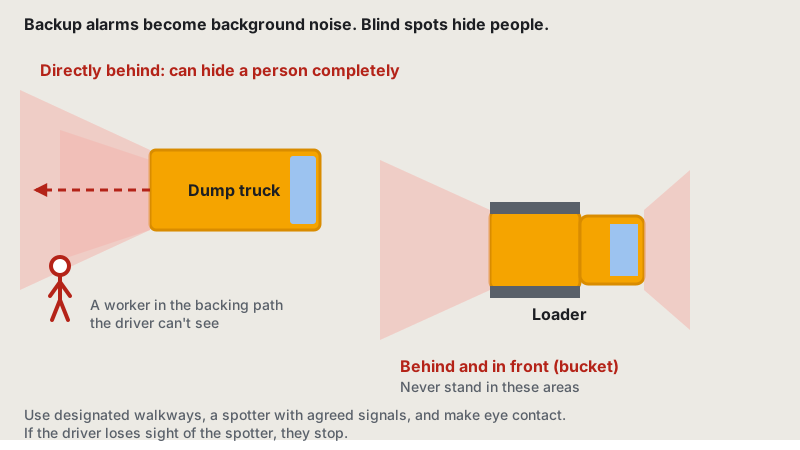
Many struck-by deaths happen when a truck or machine backs over a worker. Backup alarms become background noise, and blind spots behind large equipment can hide a person completely.
- Construction
- General Industry
What OSHA requires
In construction, a vehicle or earthmoving machine with an obstructed view to the rear may only back up if:
- It has a working backup alarm that can be heard above the surrounding noise, or
- A worker (spotter or observer) signals that it’s safe to back.
Many companies require both, plus cameras. An alarm alone doesn’t protect someone wearing hearing protection, working next to loud equipment, or who has stopped noticing alarms.
For drivers and operators
- Walk around the vehicle before backing.
- Use mirrors and cameras, and check them often.
- Use a spotter when your view is blocked. If you lose sight of the spotter, stop.
- Back slowly, and only as far as needed. Plan routes that limit backing.
- If you’re not sure what’s behind you: GOAL, Get Out And Look.
- Turn off the radio and keep the window down so you can hear the spotter and warnings.
- Use proximity detection (radar or tag-based warning systems) where available, but don’t rely on it alone.
Common hand signals
Signals vary by company, so agree on them before every job. Typical signals:
| Signal | Meaning |
|---|---|
| Arms raised with palms facing the vehicle, or arms crossed overhead | Stop |
| Both arms waving you toward the spotter | Come back (keep backing) |
| Hands held apart, closing together | Distance remaining |
| One arm pointing left or right | Turn the rear of the vehicle that way |
| Arms waving slowly up and down | Slow down |
Any signal you don’t understand means stop. Anyone can give a stop signal.
For spotters
- Agree on hand signals with the driver before starting.
- Stay where the driver can see you in the mirror at all times, and out of the vehicle’s path.
- Wear high-visibility clothing (and lights at night).
- Don’t do other tasks or use your phone while spotting.
- Never walk backward while guiding a vehicle unless you’re sure the path behind you is clear.
- Never stand directly behind the vehicle, or between the vehicle and a fixed object like a wall, dock or another truck. Spotters are killed in that space.
- Use a radio as well as signals when visibility or distance is poor.
Spotters get run over too. The spotter’s position must be safe first. If the driver can’t see you in the mirror, the driver can’t see you at all.
For everyone else
- Stay out of the backing path and blind spots. Use designated walkways.
- Treat every backup alarm as real.
- Get eye contact with the operator before crossing behind equipment.
Internal traffic control plan: good sites separate vehicles and pedestrians with barriers, one-way routes and pull-through areas so backing is rarely needed.
Standards & references
- 29 CFR 1926.601(b)(4): Backup alarms or observer (motor vehicles)
- 29 CFR 1926.602(a)(9): Backup alarms (earthmoving equipment)
Last updated: