Telehandlers (Rough-Terrain Forklifts)
Telehandlers (often called by brand names like Lull or SkyTrak) lift loads high and far on rough ground. Their capacity drops quickly as the boom extends, and many tip-overs happen when operators ignore the load chart.
- Construction
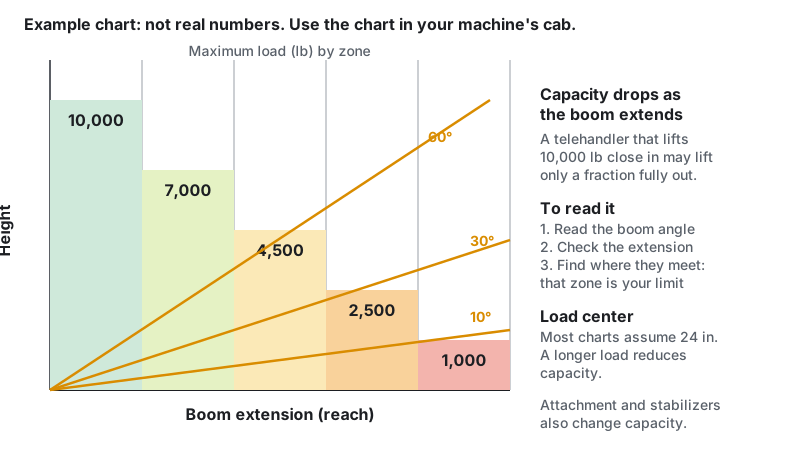
Photo: telehandler load chart in the cab, with boom angle and extension markers
Know the load chart
- Capacity depends on the boom angle, extension, attachment and whether outriggers or stabilizers are down.
- A telehandler that can lift 10,000 pounds close in may only lift a fraction of that fully extended.
- Use the load chart for the specific attachment you’re using. Every attachment has its own chart.
Reading the chart
- Find the chart for the attachment you’re using (forks, bucket, truss boom, jib).
- Check the boom angle on the angle indicator on the side of the boom.
- Check how far the boom is extended using the letters or numbers on the boom sections.
- Find where the angle line and extension meet on the chart. The zone tells you the maximum load.
- Check the load center. Most charts assume a 24-inch load center; a longer load reduces capacity.
Many newer machines have load moment indicators that warn or stop the boom as you approach the limit. Don’t override them.
Training
OSHA treats telehandlers like other powered industrial trucks for training. Operators must be trained and evaluated on the type of machine and the job conditions, and re-evaluated at least every three years or after an incident or near-miss. Familiarize yourself with each new model; controls and charts differ. See Forklifts.
Pre-shift check
- Load charts for each attachment are in the cab and readable
- Tires, wheels and stabilizers in good shape
- No hydraulic leaks; boom wear pads and chains OK
- Attachment locked on with the pin or coupler fully engaged
- Frame leveling, boom functions, brakes, steering modes, horn, lights and backup alarm work
- Seatbelt and cab (ROPS/FOPS) undamaged
Operating
- Level the frame (frame sway/leveling) before raising the boom.
- Travel with the boom retracted and the load low.
- Lower and retract the boom before moving. Don’t drive with a load raised high.
- Watch for overhead power lines and obstructions.
- Wear the seatbelt; trained and evaluated operators only.
- Don’t use a telehandler as a crane (suspended loads) unless it has a rated attachment and chart, and you follow the crane rules where they apply.
- Don’t lift people unless using a platform approved by the manufacturer for that model, with the machine set up per the manual.
- Don’t let people walk under the boom or load.
- Don’t level the frame with the boom raised.
- Don’t jump out if the machine starts to tip. Stay belted in, hold on and lean away from the impact.
Landing loads on roofs and floors
- Make sure the receiving surface can hold the load. Stacks of roofing or drywall can overload a deck.
- Workers receiving loads at an edge need fall protection; the guardrail may have to be opened.
- Set the load down fully and lower the forks before anyone reaches for it.
- Back the forks out slowly, watching for anything snagged.
Video: reading a telehandler load chart
Standards & references
- 29 CFR 1926.602(c)–(d): Lifting and hauling equipment
- 29 CFR 1910.178: Powered industrial trucks (training)
Last updated: