Lift Planning & Critical Lifts
Every crane lift needs a plan, even if it’s a quick one. Bigger, heavier or more complex lifts need a written plan reviewed by qualified people before anyone touches the controls.
- Construction
- General Industry
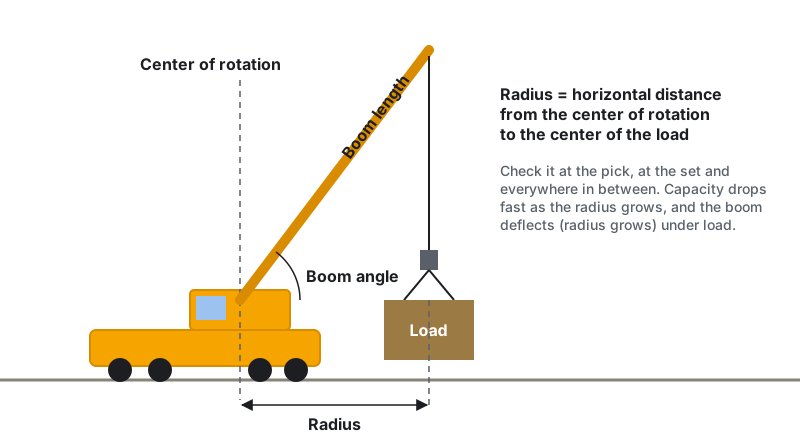
Every lift plan answers
- Weight: load plus rigging, hook block and any attachments
- Radius: from the crane’s center of rotation to the load’s center at pick and at set, and anywhere in between
- Capacity: from the crane’s load chart for that configuration (boom length, counterweight, outriggers)
- Ground and set-up: ground bearing, mats, outrigger positions
- Path: obstructions, power lines, people and public areas under the load path
- Rigging: sling type, angles, capacity, softeners
- People: operator, qualified rigger, signal person, lift director, and how they’ll communicate
- Weather: wind limits
Getting the weight right
Most crane accidents start with a wrong number. Get the weight from shipping papers, drawings, the manufacturer or a scale, not a guess. Then add everything else the crane is holding:
- Hook block or overhaul ball
- Slings, shackles, spreader bars and other rigging
- Wire rope below the boom tip, on long-boom lifts
- Stowed or erected jibs, if the chart requires a deduction
Rough weights for estimating: steel is about 490 pounds per cubic foot, and concrete about 150 pounds per cubic foot. When in doubt, weigh it or ask an engineer.
Reading the load chart
- Use the chart for the exact configuration: boom length, counterweight, outrigger extension and the area you’ll swing through.
- Capacity drops fast as radius increases. Check capacity at the longest radius the load will reach, not just the pick.
- Some charts have shaded areas limited by structural strength, not tipping. You won’t feel the crane tip before something breaks.
- Many companies set their own limits below 100% of the chart.
- The load moment indicator (LMI) is a backup, not a replacement for the plan.
Ground bearing
Divide the outrigger load (from the manufacturer’s software or chart) by the area of the mat under it to estimate ground pressure. Compare that with what the ground can hold. Soft soil, fresh backfill, buried utilities, voids and slopes all reduce what the ground can take. Large lifts often need an engineer to check the ground.
Critical lifts
Many companies define a “critical lift” and require a written, engineered plan for it. Common triggers include:
- Lifts above a set percentage of the crane’s rated capacity (often 75%)
- Tandem lifts using two or more cranes
- Lifting personnel in a platform
- Lifts near power lines or over occupied buildings or live process equipment
- Unusual, high-value or hard-to-replace loads
Pre-lift meeting
Review the plan with the whole crew: roles, signals, the load path, exclusion zones, and what to do if something goes wrong. Anyone can stop the lift.
Stop the lift if
- The load weighs more than expected, or the LMI warns unexpectedly
- The crane settles, an outrigger sinks or the crane goes out of level
- Wind picks up beyond the plan’s limit
- The signal person loses sight of the load or communication drops
- Someone enters the exclusion zone
- Rigging shifts or the load hangs out of level
See Crane Safety Basics, Rigging Basics and Crane Hand Signals.
Standards & references
- 29 CFR 1926.1417: Operation (load charts, procedures)
- 29 CFR 1926.1432: Multiple-crane/derrick lifts
- 29 CFR 1926.1431: Hoisting personnel
Last updated: