Extension Ladders
Extension ladders lean against a structure to reach an upper level, like a roof, a second floor or a platform. Set up wrong, they slide out at the bottom, tip sideways, or kick out at the top. Aluminum extension ladders are also a leading cause of electrocutions when they touch overhead lines.
- Construction
- General Industry
Choosing the ladder
- Length: The ladder’s labeled length is not its working length. Sections overlap, the ladder leans at an angle, and it must extend 3 feet past the landing. A 24-foot ladder typically reaches a roof edge of about 18 to 20 feet. Check the manufacturer’s chart.
- Duty rating: Use Type I (250 lb), IA (300 lb) or IAA (375 lb) on jobsites. The rating includes you, your tools and your materials.
- Material: Use fiberglass if there’s any chance of contact with electrical lines or equipment.
The 4-to-1 rule
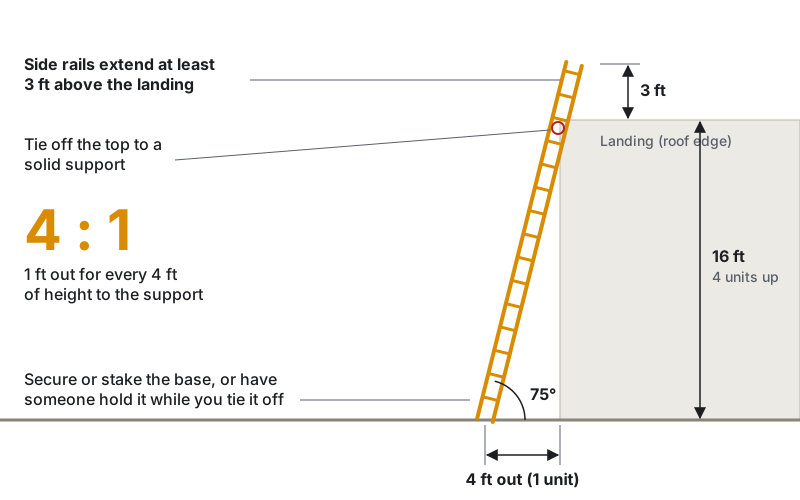
For every 4 feet of height to where the ladder touches the support, place the base 1 foot out from the wall. A 16-foot working height means the feet go 4 feet out (about a 75° angle).
Quick check: stand at the base with your toes touching the ladder feet and extend your arms straight out. Your palms should just reach the rung in front of you.
- Too steep and the ladder can tip backward when you lean out.
- Too flat and the feet slide out, or the ladder bends in the middle.
Section overlap
The sections must overlap enough for the ladder to be strong. Follow the label. A common guide for two-section ladders:
| Ladder length | Minimum overlap |
|---|---|
| Up to 36 feet | 3 feet |
| Over 36 up to 48 feet | 4 feet |
| Over 48 up to 60 feet | 5 feet |
Setting it up
- Look up first. Check for overhead power lines before raising the ladder. Stay at least 10 feet away, and farther from high-voltage lines.
- Inspect the ladder: rails, rungs, rung locks, rope and pulley, feet and labels.
- Place the feet on firm, level ground. Use ladder levelers, not blocks or bricks. Turn the feet spurs down on soil, and pads flat on hard floors.
- Raise the ladder with the fly section on the correct side (per the label), and extend it so the rung locks are fully engaged.
- Keep the minimum overlap between sections shown on the ladder label.
- If you’re climbing onto a roof or platform, the side rails must extend at least 3 feet above the landing.
- Rest both rails evenly on a solid surface. Use a standoff (stabilizer) to span a window or keep the ladder off gutters.
- Secure it: tie off the top to a solid support, and secure or stake the base, or have someone hold the base while it is being secured.
Climbing and working
- Keep three points of contact and face the ladder.
- Carry tools in a belt or raise them with a hand line.
- Keep your belt buckle between the rails. Move the ladder instead of reaching.
- Don’t stand above the fourth rung from the top.
- When stepping off onto a roof, step to the side through the rails, holding on.
- Barricade the base if it’s in a doorway, walkway or traffic area.
- Don’t use an extension ladder in two pieces, or use the top section alone (it has no feet).
- Don’t move or extend the ladder while someone is on it.
- Don’t set the top against a window, a pole, or an unstable surface.
- Don’t set it up on a truck bed, scaffold or lift to gain height.
- Don’t lash two ladders together to make a longer one.
- Don’t use it in high wind, or when it’s wet, icy or muddy.
Carrying it
Carry long ladders with two people, or balanced on your shoulder with the front end raised above head height. Watch out for power lines, people and doorways when turning. Lower the fly section fully before carrying.
Standards & references
- 29 CFR 1926.1053(b): Use of ladders (angle, 3-foot extension, securing)
- 29 CFR 1910.23: Ladders (general industry)
- ANSI A14.2 and A14.5: Portable metal and fiberglass ladders
- See also: Ladder Safety Basics · Overhead Power Lines
Last updated: