Asbestos Laws Explained
Asbestos is covered by several different federal laws, each run by a different agency with a different goal. OSHA protects workers. EPA protects the public and the environment during renovation, demolition and disposal, and protects children in schools. States and cities add their own rules on top. This page explains who does what, so you know which rules apply to your job.
- Contractors
- Building owners
- Abatement
- Demolition
- Colorado
- Connecticut
- Illinois
- Kentucky
- Louisiana
- Maine
- Massachusetts
- New Hampshire
- Oklahoma
- Rhode Island
- Texas
- Utah
Part of our asbestos deep dive: Asbestos basics · Licenses & training · Rules by state · For homeowners
The big picture
| Law or rule | Agency | Who it protects | What it covers |
|---|---|---|---|
| OSHA asbestos standards | OSHA (and state OSHA plans) | Workers | Exposure limits, work practices, training, respirators and medical exams for anyone who works around asbestos |
| Asbestos NESHAP (Clean Air Act) | EPA, usually delegated to state or local air agencies | The public and the environment | Inspection before renovation and demolition, notification, removal work practices and disposal |
| AHERA | EPA (some states run it) | Students and school staff | Inspections, management plans and accredited people in K–12 schools |
| ASHARA and the Model Accreditation Plan | EPA and states | Building occupants and workers | Training and accreditation for people who inspect, design, supervise and do asbestos work in schools and public and commercial buildings |
| TSCA asbestos rules, including the ban | EPA | Everyone | Manufacturing, importing and new uses of asbestos |
| State and local rules | State health, labor or environmental agencies; cities and counties | Workers and the public | Licensing, notification and fees, rules for homes, and disposal |
OSHA: protecting workers
OSHA has three asbestos standards: construction (29 CFR 1926.1101), general industry (29 CFR 1910.1001) and shipyards (29 CFR 1915.1001). Most building work, including renovation, repair, maintenance, demolition and abatement, falls under the construction standard.
Key requirements
- Exposure limits: 0.1 fiber per cubic centimeter averaged over 8 hours, and an excursion limit of 1.0 fiber per cubic centimeter over 30 minutes.
- Exposure assessment: employers must measure or objectively show workers’ exposure before and during the work.
- Building owner duties: owners must identify asbestos and presumed asbestos (PACM) before work and tell contractors, employers and their own workers where it is.
- Work classes I–IV with specific controls and training for each. See the table on our Asbestos page.
- Competent person: a trained person who supervises the work, sets up regulated areas and makes sure controls work.
- Regulated areas with warning signs, limited access, and no eating, drinking or smoking.
- Required methods: wet methods, HEPA vacuums, prompt cleanup and disposal in leak-tight containers.
- Prohibited practices: high-speed abrasive saws without proper controls, compressed air for cleaning, dry sweeping and shoveling (with limited exceptions), and employee rotation to reduce exposures.
- Respirators, protective clothing and decontamination facilities based on the work class and exposure.
- Medical surveillance for workers doing Class I, II or III work for 30 or more days a year, or exposed above the limits.
- Records: exposure records kept for 30 years, and medical records for the length of employment plus 30 years.
- Signs and labels: regulated areas are posted with “DANGER – ASBESTOS – MAY CAUSE CANCER – CAUSES DAMAGE TO LUNGS – AUTHORIZED PERSONNEL ONLY,” and waste and contaminated items carry warning labels.
In states and territories with their own OSHA-approved plans for private employers, the state enforces rules that are at least as protective, and sometimes stricter. See State OSHA Plans.
EPA asbestos NESHAP: renovation, demolition and disposal
The National Emission Standard for Hazardous Air Pollutants for asbestos (40 CFR Part 61, Subpart M) keeps asbestos fibers from being released into the air during renovation, demolition and waste handling. EPA has delegated it to most states and many local air agencies, so you usually deal with a state or county office.
What buildings it covers
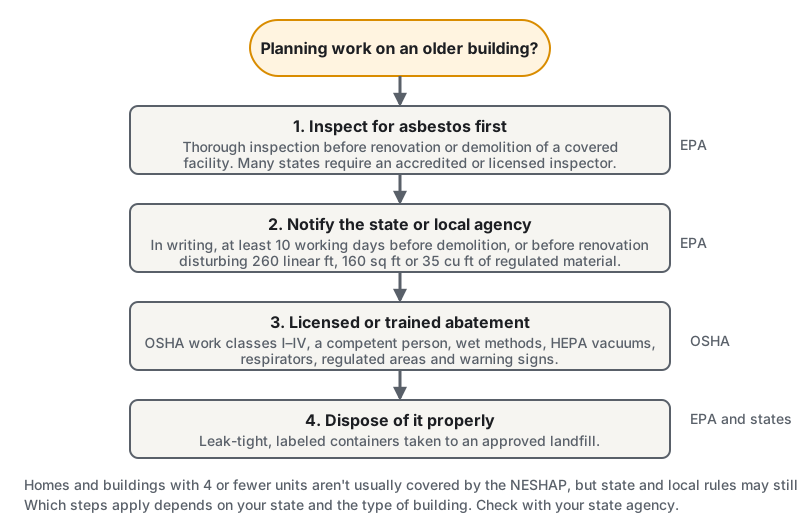
The NESHAP applies to “facilities”: commercial, industrial, institutional and public buildings, and residential buildings with more than four dwelling units. Homes and residential buildings with four or fewer units are generally not covered, unless they’re part of a larger project (such as several houses demolished for a highway or development), or are demolished by a government for reasons like urban renewal. State and local rules may cover homes even when the NESHAP doesn’t.
What it requires
- Thorough inspection for asbestos before any renovation or demolition of a covered facility. Many states require the inspector to be accredited or licensed.
- Written notification to the state or local agency at least 10 working days before:
- Any demolition of a covered facility, even if no asbestos was found, and
- Renovations that disturb regulated asbestos-containing material (RACM) of at least 260 linear feet on pipes, 160 square feet on other components, or 35 cubic feet.
- Removal before demolition: RACM must be removed before demolition or any activity that would break it up.
- Work practices: keep material wet, lower it carefully instead of dropping or throwing it, and seal it in leak-tight containers.
- A trained on-site representative, such as a foreman, who has completed NESHAP training, must be present when RACM is being disturbed.
- No visible emissions to the outside air.
- Disposal: waste must be wetted, sealed, labeled with the generator’s name and location, tracked with a waste shipment record, and taken to a landfill approved to accept asbestos.
What counts as “regulated” asbestos material
- Friable asbestos material (can be crumbled by hand pressure when dry)
- Category I non-friable material (asbestos packings, gaskets, resilient floor covering and asphalt roofing) that has become friable, or will be sanded, ground, cut or abraded
- Category II non-friable material (such as asbestos cement siding) that has a high chance of being crumbled or pulverized during the work
AHERA: asbestos in schools
The Asbestos Hazard Emergency Response Act (40 CFR Part 763, Subpart E) applies to public school districts and non-profit private schools, including charter and religious schools, for grades K–12. Schools must:
- Have accredited inspectors inspect every school building for asbestos-containing building material
- Keep an asbestos management plan for each school, written by an accredited management planner and available to the public
- Re-inspect every 3 years and do periodic surveillance every 6 months
- Notify parents, teachers and staff about asbestos activities at least once a year
- Name a designated person responsible for the program
- Train custodial and maintenance staff (2 hours of awareness training, and 16 hours for those who may disturb asbestos)
- Use only accredited people for inspections, management plans, abatement design and abatement
Twelve states have an EPA waiver and run their own school asbestos programs: Colorado, Connecticut, Illinois, Kentucky, Louisiana, Maine, Massachusetts, New Hampshire, Oklahoma, Rhode Island, Texas and Utah.
Accreditation: ASHARA and the Model Accreditation Plan
The Asbestos School Hazard Abatement Reauthorization Act of 1990 extended accreditation requirements beyond schools to public and commercial buildings. EPA’s Model Accreditation Plan sets minimum training for five disciplines: worker, contractor/supervisor, inspector, management planner and project designer. Most states run their own accreditation or licensing programs that meet or exceed the plan. See Asbestos Licenses & Training.
Bans on asbestos products (TSCA)
- 1970s and 1980s: EPA and the Consumer Product Safety Commission banned spray-applied asbestos insulation, some patching compounds and other products.
- 1989: EPA issued a broad ban, but a federal court overturned most of it in 1991. Bans on a few products, such as flooring felt and some papers, and on new uses of asbestos, survived.
- 2024: EPA finalized a rule banning ongoing uses of chrysotile asbestos, the last type still imported into the United States, with phase-out periods for some industrial uses. Parts of the rule have faced legal challenges, so check EPA for current status.
Important: These bans don’t remove asbestos already in buildings. Millions of homes, schools and commercial buildings still contain asbestos materials installed decades ago, and the worker and NESHAP rules still apply when they’re disturbed.
Other rules that can apply
- Transportation: asbestos waste shipped off site is a hazardous material under U.S. Department of Transportation rules, with packaging, labeling and shipping-paper requirements.
- Solid waste rules: states set rules for which landfills accept asbestos and how it must be packaged, even for homeowner waste.
- Building permits: many cities and counties require proof of an asbestos survey or abatement before issuing a demolition or renovation permit.
- Disclosure: some states require sellers or landlords to disclose known asbestos.
Which rules apply to my project?
| Situation | Usually applies |
|---|---|
| Contractor renovating an office building | OSHA, NESHAP (inspection and possibly notification), state licensing and notification, local permits |
| Demolishing a commercial building | OSHA, NESHAP (inspection and notification always), state rules, local permits |
| Maintenance staff in a school | OSHA, AHERA (training, management plan), state rules |
| Contractor hired to remodel a single-family home | OSHA (for the contractor’s workers); state licensing, inspection and notification rules vary widely; NESHAP usually does not apply |
| Homeowner working on their own house | Often exempt from licensing and NESHAP, but not everywhere. State and local rules and disposal rules still apply. See Asbestos for Homeowners. |
| Apartment building with five or more units | OSHA, NESHAP, state rules |
Because states differ so much, always check your state’s program. See Asbestos Rules by State.
Standards & references
- 29 CFR 1926.1101: Asbestos (construction)
- 29 CFR 1910.1001: Asbestos (general industry)
- EPA: Overview of the asbestos NESHAP
- EPA: Asbestos and school buildings (AHERA)
- EPA: Asbestos laws and regulations
- EPA: Actions to protect the public from asbestos, including the ban
Related: Asbestos · Asbestos Licenses & Training · Asbestos Rules by State · Demolition · Abatement Workers
Last updated: