Hazard Communication (HazCom / GHS)
You have the right to know what chemicals you work with and how they can hurt you. OSHA’s Hazard Communication Standard, aligned with the Globally Harmonized System (GHS), makes that happen through labels, Safety Data Sheets and training.
- Construction
- General Industry
- Minnesota
- New Jersey
What employers must have
- A written hazard communication program
- A list of hazardous chemicals used at the workplace
- Labels on every container
- Safety Data Sheets (SDS) for every hazardous chemical, available to workers on every shift. See Safety Data Sheets.
- Training before you work with the chemicals and when new hazards are introduced
Reading a GHS label
- Product identifier: the name of the chemical or product
- Signal word: “Danger” (more severe) or “Warning” (less severe)
- Hazard statements: what the hazard is, like “Causes severe skin burns”
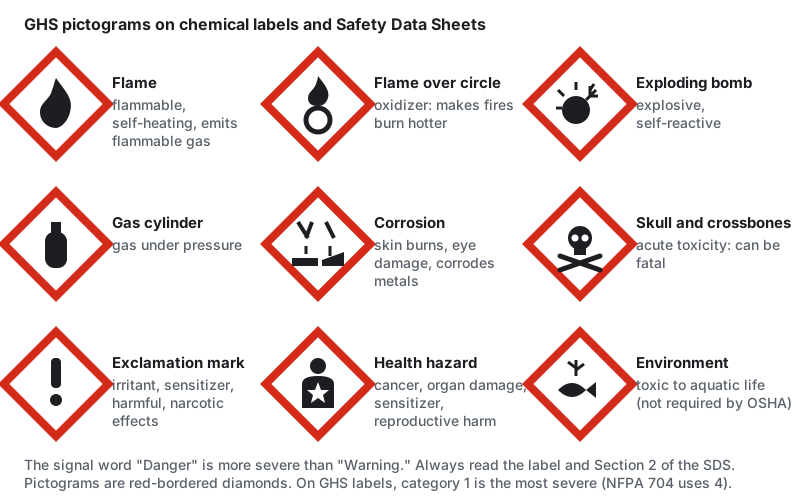
- Pictograms: red-bordered diamond symbols
- Precautionary statements: how to protect yourself, store and dispose of it, and first aid
- Supplier information: name, address and phone number
The pictograms
| Pictogram | Meaning |
|---|---|
| Flame | Flammable, self-heating, emits flammable gas |
| Flame over circle | Oxidizer (makes fires burn hotter) |
| Exploding bomb | Explosive, self-reactive |
| Gas cylinder | Gas under pressure |
| Corrosion | Skin burns, eye damage, corrosive to metals |
| Skull and crossbones | Acute toxicity (can be fatal or toxic) |
| Exclamation mark | Irritant, skin sensitizer, harmful, narcotic effects |
| Health hazard | Cancer, organ damage, breathing sensitizer, reproductive harm |
| Environment (not required by OSHA) | Toxic to aquatic life |
Secondary containers: if you pour a chemical into a spray bottle or bucket, it must be labeled with at least the product name and hazards, unless you’re the only one using it during your shift.
Common jobsite chemicals you may not think of
- Wet concrete, mortar and grout: highly alkaline and can cause serious chemical burns that you may not feel until hours later. See Hand Protection.
- Fuels: gasoline, diesel and propane are flammable, and their vapors are harmful.
- Adhesives, sealants and spray foam: may contain solvents or isocyanates. See Isocyanates and Solvents.
- Dusts from cutting concrete, stone, brick and some engineered materials contain silica. See Silica.
- Cleaners and acids: muriatic acid for masonry, degreasers and bleach. Never mix them.
- Paints and coatings: older surfaces may contain lead. See Lead.
What your HazCom training should cover
- Where the written program, chemical list and SDSs are kept
- The hazards of the chemicals in your work area
- How to detect a release, such as by odor, appearance or monitoring
- How to protect yourself: work practices, ventilation, PPE and emergency procedures
- How to read labels and SDSs
Training must be in a language and vocabulary you understand. On multi-employer sites, contractors must share information about chemicals that could affect other crews. See Multi-Employer Worksites.
Using the SDS
Every SDS has the same 16 sections in the same order. For day-to-day work, the most useful are:
- Section 2: hazards, including signal word, pictograms and hazard statements
- Section 4: first aid
- Section 5: firefighting
- Section 6: spill cleanup. See Spill Response.
- Section 7: safe handling and storage
- Section 8: exposure limits and PPE
If you are exposed
- Get away from the source and into fresh air.
- For skin or eyes, flush with water for at least 15 minutes. See Eyewash & Showers.
- Check SDS Section 4, and call 911 or Poison Control (1-800-222-1222) for serious exposures.
- Report the exposure to your supervisor, and bring the SDS or label to the doctor.
Some states have their own right-to-know laws on top of OSHA’s, such as New Jersey and Minnesota.
Standards & references
- 29 CFR 1910.1200: Hazard communication (applies to construction via 1926.59)
- OSHA: Hazard communication
Last updated: