Calculating Fall Clearance
A personal fall arrest system only works if it stops you before you hit the ground or something below you. Fall clearance is how much open space you need below the anchor or your working surface for that to happen. With a standard 6-foot shock-absorbing lanyard, you can need more than 18 feet. Many workers are tied off at heights where their system can’t possibly stop them in time.
- Construction
- General Industry
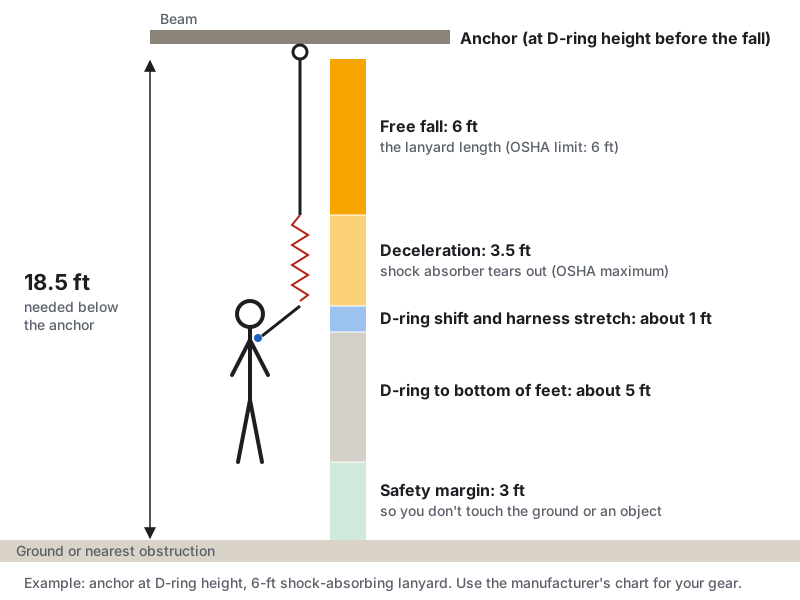
The parts of a fall
When you fall while tied off, you travel several distances one after another:
| Part | What it is | Typical value |
|---|---|---|
| Free fall distance | How far you drop before the system starts to slow you. Depends on lanyard length and where the anchor is compared with your D-ring. | OSHA limit: 6 feet (unless the equipment is designed and rated for more) |
| Deceleration distance | How much the shock absorber tears out or the SRL brake slides while slowing you | Up to 3.5 feet for a shock-absorbing lanyard (OSHA maximum) |
| D-ring shift and harness stretch | The harness shifts up your back and stretches when it catches you | About 1 foot (check the manufacturer) |
| Back D-ring height | Distance from the D-ring between your shoulder blades down to the bottom of your feet | About 5 feet for an average adult |
| Safety margin | Extra room so you don’t touch the ground or an object below | 2 to 3 feet |
Add them up to get the required fall clearance. Compare it with the actual distance from your anchor (or working surface) to the nearest thing you could hit: the ground, a lower floor, a beam, machinery, a guardrail, or material stacked below.
Example: 6-foot shock-absorbing lanyard
A worker is tied to an anchor at the same height as their D-ring (about shoulder height) using a 6-foot shock-absorbing lanyard.
| Part | Distance |
|---|---|
| Lanyard length (free fall) | 6 feet |
| Deceleration distance | 3.5 feet |
| D-ring shift and stretch | 1 foot |
| D-ring to feet | 5 feet |
| Safety margin | 3 feet |
| Required clearance below the anchor | 18.5 feet |
If the anchor is at your feet instead of at your D-ring, you fall the lanyard length plus the distance from your feet to your D-ring before the lanyard even goes tight, so free fall can reach about 11 to 12 feet. That’s beyond OSHA’s 6-foot limit unless you use a lanyard specially rated for foot-level anchors, and it needs even more clearance. Anchor overhead whenever you can.
Self-retracting lifelines (SRLs)
An SRL works like a seat belt: the line feeds out as you move and locks within a short distance when you fall. Because free fall is short, SRLs usually need much less clearance than a lanyard, often less than 10 feet total when anchored overhead. Exact numbers depend on the model, so always use the manufacturer’s clearance chart.
- Overhead anchoring: standard SRLs are designed to be anchored above your D-ring.
- Foot-level or leading edge use: only use SRLs rated for it (often called SRL-LE or Class 2). The line can bend over an edge, and these units need more clearance.
- Shorter falls: the closer the SRL is to directly above you, the shorter the fall and the less swing.
See Self-Retracting Lifelines.
Horizontal lifelines add distance
A horizontal lifeline sags when it catches a falling worker, and that sag adds to your fall distance. The amount depends on the span, the line’s tension and how many workers are attached. Horizontal lifelines must be designed and installed under the supervision of a qualified person, who calculates the clearance. See Horizontal Lifelines.
Swing falls
If your anchor isn’t directly above you, you’ll swing like a pendulum after the system catches you. You can slam into a wall, column or equipment, or hit the ground as you swing down. Working far off to the side of an anchor also increases the total fall distance.
- Keep your work close to directly under the anchor.
- Move your anchor point as you move, or use a horizontal lifeline or anchor trolley.
- Look for objects you could swing into, and clear them or re-plan.
When there isn’t enough clearance
On lower roofs, mezzanines, scissor lift decks, truck beds and the first floors of buildings, a fall arrest system may not be able to stop you in time. Options include:
- Guardrails, so nobody can fall at all
- Fall restraint, which keeps you from reaching the edge. See Fall Restraint Systems.
- A shorter lanyard or a positioning system where allowed
- An SRL anchored overhead, chosen with its clearance chart
- Raising the anchor with an overhead anchor, beam or mobile anchor system
Quick clearance check
- I know how far below my anchor the nearest obstruction or lower level is
- I know the required clearance for my system (from the label or manufacturer chart)
- My anchor is at or above my D-ring, if possible
- My free fall will be 6 feet or less
- I’m working close to directly under my anchor to limit swing
- Nothing is stacked or parked below that I could hit
- There’s a rescue plan to get me down quickly if I fall
Warning: Being tied off doesn’t mean you’re protected. If the required clearance is more than the space below you, the system can’t stop your fall in time. Check before you hook up, and ask a competent person if you’re not sure.
What OSHA requires
Personal fall arrest systems must be rigged so a worker can free fall no more than 6 feet and can’t contact any lower level. They must limit the arresting force on a worker in a body harness to 1,800 pounds and bring the worker to a stop with a deceleration distance of no more than 3.5 feet. Employers must also provide for prompt rescue.
Standards & references
- 29 CFR 1926.502(d): Personal fall arrest systems (construction)
- 29 CFR 1910.140: Personal fall protection systems (general industry)
- ANSI/ASSP Z359 Fall Protection Code, including Z359.14 for self-retracting devices
Related: Personal Fall Arrest Systems · Anchorage Points · Fall Rescue · Leading Edge Work
Last updated: