Self-Retracting Lifelines (SRLs)
A self-retracting lifeline works like a seat belt: the line feeds out as you move and locks almost instantly if you fall. That means shorter falls, lower forces on your body and less clearance than a 6-foot shock-absorbing lanyard. But an SRL only works as designed when it’s anchored where the manufacturer intended.
- Construction
- General Industry
How an SRL works
Inside the housing, a spring-loaded drum keeps light tension on the line. When the line pulls out suddenly, as in a fall, a brake locks it, usually within a couple of feet. Many SRLs also have an energy absorber, either inside the housing or as a tear-away pack near the hook, to soften the stop.
Types
| Type | Typical use |
|---|---|
| Personal SRLs (personal fall limiters) | Short (about 6 to 11 feet), lightweight units that attach at the back D-ring. Often twin-leg for 100% tie-off while moving. |
| Web or cable SRLs | Longer units (20 to 100+ feet) mounted to an overhead anchor, beam trolley or tripod. |
| Leading-edge SRLs | Built and tested for foot-level anchors where the line could run over an edge. |
| SRLs with rescue winches | Used for confined spaces and some rescue plans. The winch can raise or lower a fallen worker. |
Reading the label
ANSI Z359.14 sorts SRLs into classes. Newer labels say Class 1 (overhead anchorage only) or Class 2 (overhead or foot-level anchorage, tested over an edge). Older units may say Class A or Class B, which describe arrest distance. The label also shows the weight range, the required clearance and any limits on anchor location. Read it before every new set-up.
Overhead vs. leading edge
Standard SRLs are designed to be anchored overhead. If the anchor is at your feet, or the line could run over an edge during a fall, you need an SRL rated for leading edge (foot-level) use. A standard line can be cut by a sharp edge, and a foot-level anchor means a longer free fall. See Leading Edge Work.
Clearance and swing falls
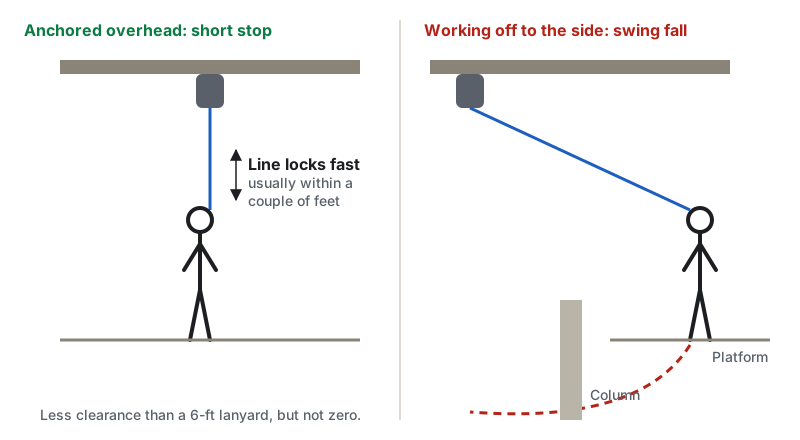
- An SRL anchored overhead usually needs less clearance than a lanyard, but not zero. Check the manufacturer’s clearance chart.
- Foot-level anchors need much more clearance. Some personal SRLs need 15 feet or more at foot level.
- Working far off to the side of the anchor creates a swing fall. You can hit objects, and the line can drag over edges. Stay within the angle shown in the instructions and move the anchor as you go.
See Calculating Fall Clearance.
Twin-leg personal SRLs
- Use both legs to move past obstacles. Connect the second leg before disconnecting the first.
- Attach the unused leg only where the manufacturer allows, usually a breakaway lanyard keeper. Never clip it to your tool belt or a side D-ring.
- Make sure the twin-leg unit is rated for the way you’re using it. Connecting both legs to anchors at once can change how it performs.
Inspect before each use
- Housing not cracked or damaged; labels readable
- Line extends and retracts smoothly along its full length
- Webbing has no cuts, burns, chemical damage or frayed edges; cable has no kinks, broken strands or corrosion
- Pull sharply: the unit locks immediately
- Impact or fall indicator not deployed
- Energy absorber pack intact (if equipped)
- Snap hook or carabiner closes and locks on its own
- Inspected by a competent person at least yearly (more often in harsh conditions), and factory serviced on the manufacturer’s schedule
Any SRL that has stopped a fall must be removed from service until the manufacturer or an authorized service center inspects it.
Care and use
- Don’t let the line retract freely back into the housing. Guide it in.
- Don’t use an SRL to lift or lower materials.
- Don’t tie knots in the line or wrap it around a beam and hook it back on itself unless it’s designed for that.
- Don’t let the line rest on sharp edges, hot surfaces or welding spatter.
- Don’t extend an SRL with another lanyard.
- Don’t leave SRLs in the sun, rain or a hot truck bed when not in use.
Standards & references
- ANSI/ASSP Z359.14: Self-retracting devices for personal fall arrest and rescue systems
- 29 CFR 1926.502(d): Personal fall arrest systems
- 29 CFR 1910.140: Personal fall protection systems (general industry)
- See also: Personal Fall Arrest Systems · Harness Inspection & Fitting
Last updated: